
6m / 50MHz Dual Polarity - X-pol Array @ F56BKI by G0KSC
10 Jan 2016
F6BKI builds a 4 x LFA Yagi array with elements both vertically and horizontally stacked, what are the benefits?
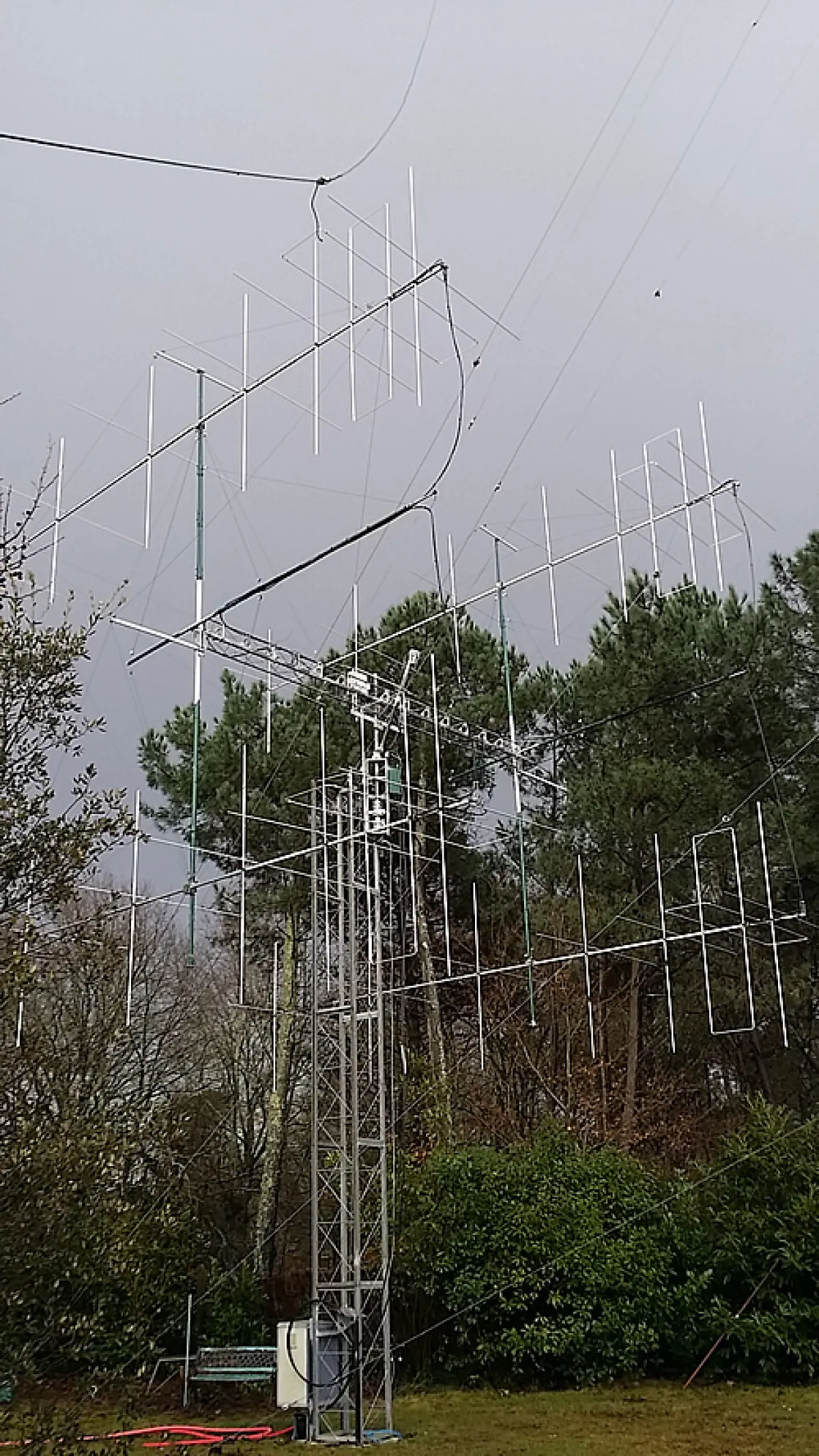
Impressive - 4 x 7el X-pol LFA Yagis @ F6BKI

Building an array of this size requires a lot of time, effort and financing too so needs to be worthwhile so what are the associated benefits with building such an array?
EME Arrays and 4-stacks
With this particular installation the only consideration is that of EME or Earth Moon Earth communication. This is one where the array is pointed to the Moon and signals sent and received from it. Of any signals that hit the Moon, only 7% are reflected in an Earth bound direction and with 250,000 miles or so between the Moon and Earth, very weak signals re-enter our planet’s atmosphere and are available to be received.
EME has been around for many years but has become extremely popular in more recent years after the introduction of digital modes by K1JT that allow far weaker two-way communications to occur. Even signals not audible to the human ear can be decoded using the JT suite of software and this has led to far smaller stations (in terms of antenna hardware) being able to be used for two-way communications via the Moon.
Needless to say this is one of the reasons 4 antennas are used as the combined antenna the 4 Yagis create, increase gain which will ensure weaker signals can be heard. However, it is also important that the base antennas used to create the stack of 4 Yagis (typically using an H-shaped frame to support them) have been optimised for minimum side lobes in any direction other than that the antenna is facing. This might seem a logical assumption but many antenna designers and manufacturers have a rather blinkered view that gain is everything and you should stop at nothing to achieve as much gain as possible. This is not true and is only part of the picture, I go into more detail in this section HERE and with a 50MHz focus HERE. The starting point for any such array should be a Yagi which has been optimised for best Signal to Noise Ratio (SNR or SNR Yagi) to ensure you can hear as well as be heard, another scenario not achieved often when more than a few hundred Watts are used at the transmitter.
Stacking Distances & Symmetry
The distance between each antenna in a 4 stack is important too in order to minimise side-lobes. A standard for stacking distances is a formula designed many years ago by DL6WU and even today this is used extensively. However, this formula in most cases allows large side-lobes to appear, especially when SNR Yagis are used as a base antenna and so manual optimisation is required. Another interesting consideration is the spacing between antennas on an H-frame which should by Symmetrical, 3m x 3m or 6m x 6m for example in order that when switching polarity, the pattern shape stays the same. Ultimatley, the final spacing used, depends on the individual Yaigs beamwidth and pattern shape.
X-pol and MAP65 benefits
There are two reasons X-pol or dual polarity systems are not seen so much on the 50MHz band. The first is the physical size and structure dampens the enthusiasm of most Hams, next the financial implications are often excessive and also the associated benefits on this band being far less than they would be on 144MHz or 432MHz bands. Faraday Rotation is the main issue any EME'er is faced with and the reason for wanting to install an X-pol system. This is a phenomenon which involves the rotation of the transmitted signal as it passes (twice) through the Earth's atmosphere and covers the mileage that it does travelling to the Moon and back. Often, while a signal is transmitted in one plane (Vertical for example) the received signal after its round trip to the moon arrives Horizontally polarised and thus in the opposing plane to that it was transmitted in. In some cases, the signal may still be received but consideration has to be given to the fact that there is a 20dB reduction in signal strength if you are transmitting in one polarisation and receiving in another and also that the received signal is very weak with it arrives back on Earth for the above mentioned reasons. Therefore, a QSB (fading signal) scenario may occur leading to longer durations being required to complete a QSO (radio communication). On 50MHz Faraday rotating is often quite fast so the impact minimal. 144MHz it is much slower and on 432MHz long duration 'lock-out' situation can often occur meaning signal transmitted in one plane arrive back in the opposing plane and remains that way for days on end. This would result in very limited EME activity unless X-pol systems were being used, at least at one side of the QSO.
Having the ability to receive in both horizontal and vertical planes at the same time, allows the user to see and hear signals they may not otherwise receive if they had just one polarisation on their antenna system. However, the associated benefits do not stop there.